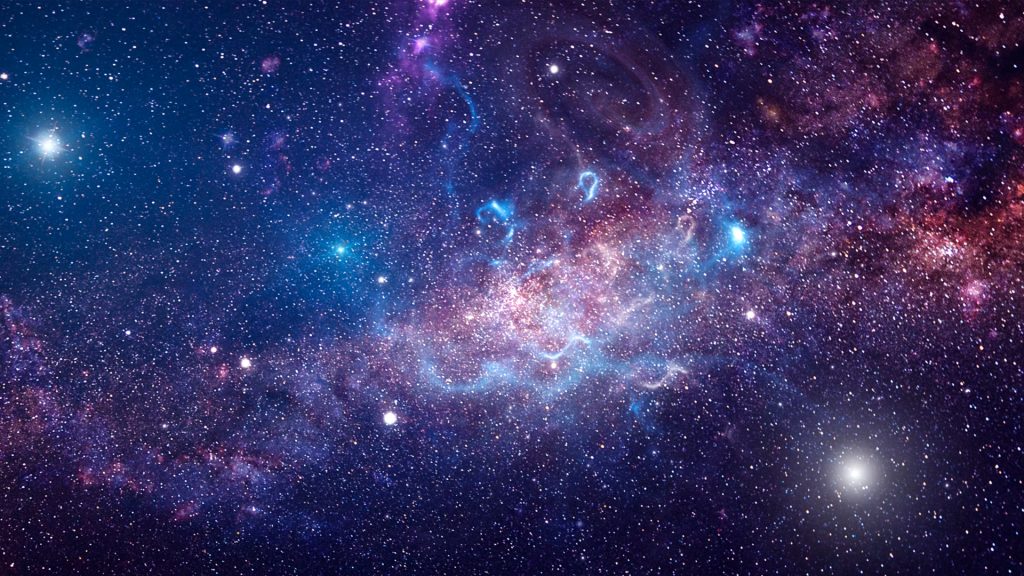
Exploring Dark Matter: The Invisible Fabric of the Cosmos
Dark matter is one of the most profound mysteries of modern astrophysics, comprising about 27% of the universe yet remaining unseen and undetectable through conventional means. Unlike ordinary matter, which makes up stars, planets, and galaxies, dark matter does not emit, absorb, or reflect light, making it invisible to our most powerful telescopes. Scientists infer its existence primarily through its gravitational effects on visible matter, such as the rotation of galaxies and the bending of light around massive clusters. This enigmatic substance has sparked a plethora of theories, from particle physics to cosmology, leading researchers to explore its role in the formation of cosmic structures.
The exploration of dark matter has accelerated in recent years, thanks to advancements in technology and our understanding of the universe. Numerous experiments and observations, including those from the Large Hadron Collider and various space telescopes, aim to unveil the secrets hidden within this mysterious fabric of the cosmos. Potential candidates for dark matter particles, such as Weakly Interacting Massive Particles (WIMPs) and axions, continue to be studied, but the quest for definitive proof remains ongoing. As we stand on the brink of a new era in astrophysics, unraveling the mysteries of dark matter could not only reshape our understanding of the universe but also reveal the fundamental laws that govern it.
Counter-Strike is a popular multiplayer first-person shooter game that pits teams of terrorists against counter-terrorists. Players can choose from various game modes and maps, utilizing strategy and teamwork to achieve objectives. For those looking to enhance their gaming experience, check out the Top 10 Samsung Galaxy Ultra Accessories to optimize your setup and gameplay.
What Lies Beyond Our Observable Universe?
As we gaze at the cosmos, the vastness of the universe fuels our curiosity about what lies beyond our observable universe. Existing theories suggest that the observable universe is merely a fraction of the entirety of space, potentially extending infinitely. Some scientists propose that the universe could be part of a larger multiverse, where different realms operate under varying physical laws. This hints at an expansive reality that challenges our understanding of physics and existence itself.
One intriguing possibility is that beyond the observable universe, there are regions we cannot detect due to the finite speed of light. As space expands, regions that were once visible may eventually drift beyond our observational reach, creating a cosmic horizon. According to some models, these distant areas may host their own galaxies, stars, and even life forms, which we may never be able to observe. Such concepts, while abstract, push the boundaries of cosmology and ignite our imagination about the ultimate fate of our universe.
The Life Cycle of Stars: From Birth to Supernova
The life cycle of stars is a fascinating journey that begins in stellar nurseries, where gas and dust clouds, known as nebulae, come together under the force of gravity. As these materials collide and clump together, the core begins to heat up and eventually ignites nuclear fusion, marking the birth of a new star. Depending on its mass, a star can enter one of two primary pathways: becoming a main sequence star or directly evolving into a massive star. Main sequence stars, like our Sun, spend a substantial portion of their lives fusing hydrogen into helium, while more massive stars quickly exhaust their nuclear fuel and progress through shorter life cycles.
As stars age, they undergo a series of evolutionary stages that can lead to spectacular endings. For low to medium-mass stars, the conclusion of their life cycle results in the formation of a planetary nebula and a white dwarf. In contrast, the death of massive stars culminates in a cataclysmic explosion known as a supernova. This dramatic event disperses materials into the universe, contributing to the formation of new stars and planets. The remnants of the supernova may leave behind a neutron star or even collapse into a black hole. Thus, the cycle of stellar evolution highlights the dynamic processes that shape our universe, illustrating how each star's life contributes to the creation of elements fundamental to life itself.